
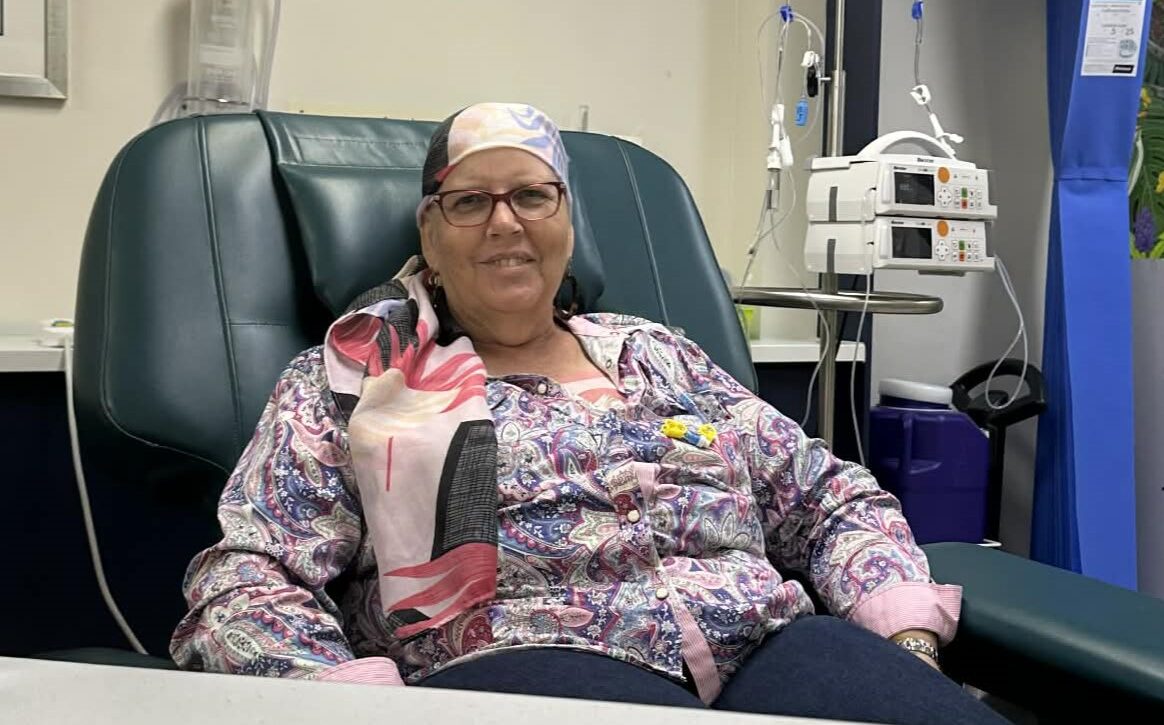
Before cancer, Tristin’s life was defined by the land. Living on a rural property two hours south of Cairns, she managed the station day-to-day while her husband worked away in a FIFO role. When he was home, they ran it together; when he wasn’t, the responsibility rested with her. It was physical, demanding work — managing fences, waters and stock — and it suited her just fine.
“I was pretty active before the diagnosis,” she says.
Cancer entered her life without warning in September 2024. One morning, stepping out of the shower, she noticed something didn’t look right.
“I put my arm up to dry myself and thought, that looks a bit funny,” she recalls. At first, she dismissed it as a muscle strain from the cattle yards the day before, but a visit to her GP (general practitioner) changed everything.
“I’d say right from then, she knew what she was looking at,” Tristin says. In Far North Queensland, access delays meant biopsy services weren’t immediately available. Months-long wait times were suggested, but Tristin’s GP refused to accept that.
“She said, ‘We can’t wait that long,’” Tristin explains. By fast-tracking a surgical referral before biopsy, her GP shaved months off the process. “I actually credit her with saving my life.”
The diagnosis came swiftly: stage three triple negative breast cancer, one of the rarest and most aggressive forms.
“Waiting a month or two for scans would have made a big difference,” Tristin says. “I’d had a clear mammogram less than 12 months earlier, and suddenly I had a tumour the size of a golf ball.”
The treatment plan was aggressive. Alongside neoadjuvant chemotherapy and immunotherapy, Tristin underwent a bilateral mastectomy, and a lymph node clearance
“You don’t really have time to process it,” she says. “You’re just told, this is what has to happen.”
What followed was 17 months of intensive treatment: chemotherapy, immunotherapy, multiple blood transfusions, radiation, and the chemotherapy tablet capecitabine, which her body ultimately couldn’t tolerate. One of the five different chemo drugs she received was doxorubicin — known among cancer patients as the “Red Devil.”
“They call it that for a reason,” Tristin says. “It’s bright red, and it’s brutal.”
Living rurally added another layer of complexity. Radiation required long stays in Cairns, hours from home, her husband, her animals and her routine.
“Staying in town on my own was probably one of the hardest things,” she says. “I really missed my dogs. I’m a real animal lover.”
Support became essential. During her time in Cairns for treatment, Tristin found her way to COUCH Cancer Hub NQ after receiving a flyer and activity schedule from the radiation nurses at ICON Cairns.
“It was a safe place to go when I had nowhere else to go,” she says. “You can just be yourself. You can be upset, or have a laugh, or just sit quietly.”
At COUCH, she accessed nursing support, GP care, massage and exercise physiology. Just as importantly, she found connection.
“I met a friend there who was going through almost the same thing,” she says. “We still catch up and text each other. That kind of understanding is invaluable.”
Now, as she waits for a post-treatment scan, Tristin sits in a space of cautious hope.
“I won’t consider myself in remission until that scan comes back clear,” she says.
Looking ahead, she has channelled her lived experience into study, enrolling in psychological science with the long-term goal of working in psycho-oncology.
“There’s such a gap,” she says. “And I think my life journey has led me here.”
For Tristin, sharing her story is part of that path.
“If my lived experience can help somebody else,” she says, “I’m more than happy to reach out.”